Thursday, February 3, 2011

From the New World to the Old

Photograph of Joseph Brodsky and Derek Walcott (undated) / Image courtesy of the Beinecke Library

I was pleased to read in the Guardian last week that one of my favorite poets, Derek Walcott, was awarded the T. S. Eliot Prize for his recent book White Egrets (as if the Nobel Prize weren't enough). The prize is given for the best new poetry collection published in the UK or Ireland, but the candidates themselves can apparently live anywhere. (Walcott comes from the Caribbean island of Saint Lucia, and among his competitors was the American poet Brian Turner.) In any case, Anne Stevenson, who chaired the panel of judges, called White Egrets a "moving and technically flawless" work.

As it so happens, Walcott has a Russian connection, which I wrote about in my dissertation: his friendship and collaboration with Joseph Brodsky. The two men first met in the 1970s and remained close until Brodsky's death in 1996. They both contributed essays to a book on Robert Frost, and Walcott translated several of Brodsky's "nativity poems" into English (with a crib, naturally). Rumor has it that he also helped Brodsky with his self-translations of the "Part of Speech" series after Daniel Weissbort was snubbed. And Brodsky appears several times in Walcott's work, including in "Forests of Europe" and The Prodigal.

Below are the opening lines of an unpublished poem, "Dedication," that Walcott wrote for Brodsky in the early 1980s. I happened to find it while rooting around in Walcott's papers at the University of Toronto a few years back. And if I can ever figure out how to get in touch with him, I'll ask the man himself to let me publish it for him. For now, this little chunk will have to do. Enjoy!

More strength and grace to your work
I send you now, Joseph, from
the sunshine poured to the brim
of this hemisphere, to cypresses
wrestling in Tuscany, to the calcified bread
of heaven within whose holes
the anchorites died like weevils.
Joseph, we wake to wrestle devils,
and an aching cavity. Wine is stored
in the ageing cellars of the heart,
manna blossoms in the spring orchard,
and through the grid of terraces
the ancient flame is lowered after winter
and all of Italy throbs in heat.

Tuesday, December 28, 2010

Kiktenko in Ozone Park

 Abstract post-graffiti calligraphy by Nuno de Matos / Image courtesy of Ozone Park Journal

Two of my translations of poems by Vyacheslav Kiktenko appear in the Fall 2010 issue of Ozone Park Journal, which is put out by the MFA Program in Creative Writing and Literary Translation at CUNY's Queens College. Susan Bernofsky, a brilliant translator, spent the fall semester as a visiting professor in the program, which she describes in an article she wrote for Words Without Borders.

With any luck, Kiktenko's Cyrillic texts will be posted on the Ozone site soon. For now, you can read the originals here ("Заброшенный парк" and "Мальчик стоит и дивится").

Thanks to ALTA, Roger Sedarat, and Jolie Hale for making this happen!

Friday, December 24, 2010

A Nativity Poem by Joseph Brodsky

Photograph of Joseph Brodsky speaking / Image courtesy of Yale's Beinecke Library

NOTE: My English translation follows the Russian text of this poem, which is one of the first "Nativity poems" that Brodsky wrote. This poem does not appear in the collection that Farrar, Straus and Giroux put out in 2001 under the editorship of Pyotr Vail.

*     *     *

Рождество 1963 года

Спаситель родился
в лютую стужу.
В пустыне пылали пастушьи костры.
Буран бушевал и выматывал душу
из бедных царей, доставлявших дары.
Верблюды вздымали лохматые ноги.
Выл ветер.
Звезда, пламенея в ночи,
смотрела, как трех караванов дороги
сходились в пещеру Христа, как лучи.

1963 - 1964

*     *     *


Christmas, 1963

The savior was born
into fierce, brutish cold.
Shepherds’ small campfires blazed in the wasteland.
A blizzard seethed and battered the souls
of the humble kings who bore gifts for the infant.
The camels lifted their shaggy legs in sequence.
The wind howled.
The star, aflame in the night,
looked on as the paths of the three processions
converged on Christ’s cave like beams of light.

1963-1964 

Translated from the Russian by Jamie Olson

Monday, December 13, 2010

Sketchy Poet

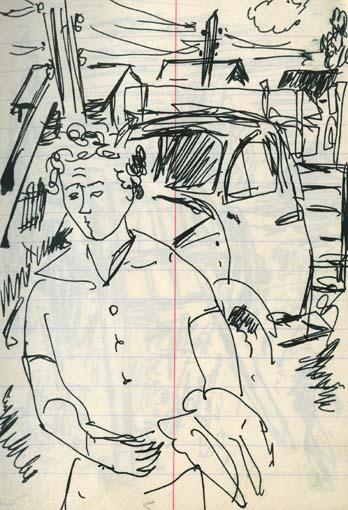
Untitled drawing by Joseph Brodsky / Image courtesy of the the National Library of Russia

Today in St. Petersburg, the National Library of Russia opened a new exhibit called "Hourglass: Drawings by Joseph Brodsky," featuring unpublished sketches by the Russian poet from a number of sources: the library's archives, the Anna Akhmatova Museum, and private collections. The exhibit also includes copies of drawings that Brodsky made during his years in the United States, as well as some of his photographs. According to the library's press release, "The drawings reflect yet another aspect of Joseph Brodsky's talent and are an important resource for the study of his life and work." Besides the images, the library has on display manuscripts of poems, excerpts from letters, and notebook entries.

As it so happens, the walls of my office at Saint Martin's University are adorned with printed copies of two drawings by Brodsky: a self-portrait and a sketch of Derek Walcott. Both come from Yale's Beinecke Library, whose website allows anyone to view a number of Brodsky's drawings and photographs from his manuscript collection. (Just search using the keyword "Brodsky.")

If any readers of this blog happen to be in St. Petersburg and find the time to drop by the exhibit at the National Library, I'd love to hear what you think! Unfortunately, the exhibit will be short-lived: it closes on December 31.

Sunday, December 5, 2010

Bella: Woman of the 'Sixties

Bella Akhmadulina / Image courtesy of Novaya Gazeta

This past Monday, Russia suffered the loss of Bella Akhmadulina, another voice from that hugely influential generation of poets who emerged in the 1960s and quickly achieved celebrity status in the Soviet Union. Alongside Yevgeny Evtushenko, Robert Rozhdestvensky, and Andrei Voznesensky (who also died this year), Akhmadulina became, according to poet and Radio Svoboda correspondent Elena Fanailova, a “feminine symbol of Khrushchev’s ‘thaw’,” appearing on stage, in popular films, and in print.

One should not forget that many poets in the Soviet Union, even major ones like Joseph Brodsky, did not have the luxury of seeing their work appear on the printed page. In fact, Akhmadulina was not always in the good graces of the authorities either: her second collection, Chills (Озноб), could only be released in tamizdat—“over there”—by a Frankfurt publisher run by Russian émigrés. And after she contributed a poem to Vasily Aksyonov’s unsanctioned almanac Metropol in 1979, Soviet officials evidently “branded her a prostitute and drug addict” in retaliation. That’s quite a fall for someone who just a decade before had helped to fill stadiums with crowds hungry for poetry.

Sunday, November 21, 2010

Erofeyev on Tolstoy

Photo of Leo Tolstoy by F. W. Taylor (c. 1897) / Image courtesy of Wikimedia Commons

The New York Times and the International Herald Tribune just ran a piece by Victor Erofeyev to mark the hundredth anniversary of Leo Tolstoy's death. Erofeyev fascinates me: he has a way of writing clear, simple prose that nevertheless manages to get at profound truths. Two of his essays that appeared in The New Yorker have stuck with me for years, and both of them go right to the foundations of Russian culture: in one, he takes up the subject of vodka; in the other, Russian cursing. (Unfortunately, the magazine won't let you read them without a subscription to the digital edition. But for excerpts from the second essay, read this post by Languagehat.)

In the new piece, Erofeyev claims to get a "physiological pleasure" from reading Tolstoy, since the novelist's words "generate smells, sounds, vibrations of feelings and moods." I suppose that's as good a definition of 'realism' as any. But most importantly, Erofeyev draws a distinction between Tolstoy and Dostoevsky that, from my perspective, hits right on the mark:
André Gide in an essay on Dostoevsky wrote that Tolstoy obscured the greatness of Dostoevsky. But with time, the prevalent view among intellectuals came to be that Dostoevsky’s mountain was higher than Tolstoy’s. Yes, Dostoevsky has clear goals and defined action. The curtain opens and we watch how a godless existence leads inexorably to sin and evil. Crime becomes punishment. By contrast, when Tolstoy’s Anna Karenina throws herself under a train, what is it? Her punishment? High tragedy? The fate of fallen women? A delirious stream of consciousness? There is no answer. For that, in Tolstoy’s logic, you go to the police, not to the writer. In Dostoevsky, life is subservient to thought. In Tolstoy, thought is in a constant spin, like the grenade that will explode and take the life of Prince Andrei Bolkonsky.
As I said, Erofeyev has a knack for expressing something simple, clear, and profoundly true. The next time I teach Russian literature, I may just have to assign this piece to my students.

Sunday, November 14, 2010

The "Blackamoor" of Peter the Great

Statue of A. S. Pushkin in St. Petersburg (on Pushkinskaya St.) 

[Note that the original title of this post was "The 'Negro' of Peter the Great." See the comments section for details.]

Curiosity about Pushkin's lineage seems as strong as ever: Serge Schmemann writes in The New York Times that an African historian, Dieudonné Gnammankou, has discovered that the Russian national poet's great-grandfather, Abram Petrovich Gannibal, was probably born in the late seventeenth century in central Africa - not the more palatable Christian kingdom of Ethiopia, as Russians had thought. When he was seven years old, Gannibal was kidnapped, possibly by a neighboring chief, from the ancient sultanate of Logone-Birni (in what is now Cameroon), and given as a gift to the Ottoman sultan in Constantinople. The Russian ambassador then "acquired" him and presented him to Peter the Great.

Printfriendly