Showing posts with label Timur Kibirov. Show all posts

Friday, September 20, 2019

Kibirov's Poplar

Image courtesy of Poetry Northwest

I've clearly been doing a terrible job of keeping up this blog, but here's a belated link to my translation of a poem by Timur Kibirov, which I was very happy to place with the venerable journal Poetry Northwest. If the gods are kind to me, there will be plenty more of his poems showing up in English in the coming years. They're piling up in my notebooks, desk drawers, and on hard drives...

The poem also appeared in Russia in the 2016 anthology 100 Poems about Moscow / 100 стихотворений о Москве, edited by Maxim Amelin with much help wrangling translators from Anne O. Fisher—or Annie, as we in the translation crowd know her.

Here are the opening two stanzas, with the Russian below the fold:


from the cycle “Romances of the Cheryomushki District”
On valor, on heroism, on the glory
of the Communist Party on the bitter earth,
on Ligachev and Okudzhava,
on the poplar that rustles in the mist.
On the poplar by my window, on you and
your warm body, on the poplar right here,
on how we’ve barely left the cradle,
the grave awaits, and nothing is clear.


(You can read the full poem and my translator's note here.)

Monday, December 25, 2017

Lenin’s Christmas: A Nativity Poem

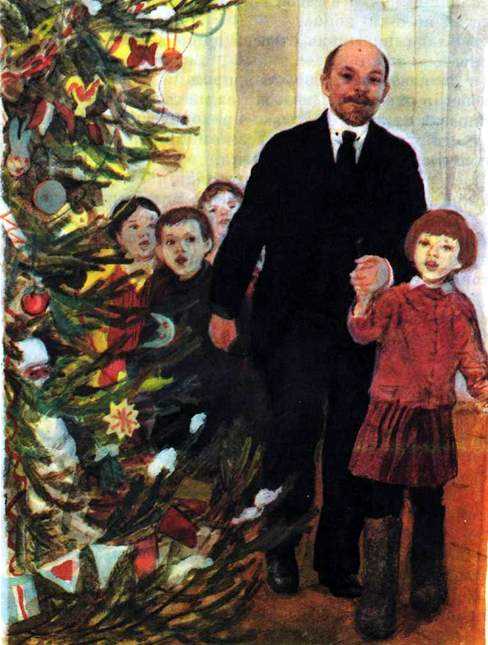
Unattributed illustration from Bonch-Bruyevich’s Lenin and the Children (1975) / Image courtesy of e-Reading

From “Christmas” (1985)
by Timur Kibirov

7
                             … Yet the Son slept
a sweet sleep, and over His brow
streamed the light from last night’s

8
Star, blending with the radiance
of the scarlet dawn.
Free from anger or sadness,
bubbles formed on
those Lips that yet again would
give the Good News, that would
grimace and spit blood
and praise the merciful Lord…

9
But the news spread, and rumor
filled the world.
At last it reached the Kremlin,
our Russian stronghold.
 And the tall blue firs rustled!
The cannon fired for the first time!
A watchman recoiled in terror!
And then from the mausoleum

10
he came. He climbed into the car.
Iron Felix sat beside him.
Behind the wheel was the “Sailor,”*
staring down anyone they passed.
They flew faster than the wind.
They drove up. They knocked.
A smile beamed
from the face of Ilyich.
He had come with New Year’s gifts:
the Peace Decree, saccharin,
a copy of the Great Initiative,
the log he’d hauled at the work party,

11
first-rate provisions, and a bouquet
of white paper roses,
just as alluring and bright
as our poet Blok evoked them.
A bust of Marx, a pioneer scarf,
a packet of blank arrest forms,
the 3rd Congress of the Komsomol,
and a bayonet from the Red Guard.

12
They left the Sailor standing
at the door. They went in.
No sooner had they seen Him
than they became bewildered
and backed away in terror.
Their faces grew pale. They trembled
and dissolved in the air… The Sailor
instantly toppled off the porch
and sprawled out like a worm.
But listen! Already, the horns

13
of battle have begun to sound
from far off in the distance.
Our armor is strong! Our hand
is firm! Our fury is righteous!
The sky quakes with thunder —
propeller, sing your furious song!
And now an NKVD squad
has got the place surrounded…

Translated from the Russian by Jamie Olson


______________

* Anatoly Grigoryevich Zheleznyakov (1895-1919), also known as “Sailor Zheleznyak,” was an anarchist, seaman in the Baltic fleet, and one of the leaders of the Bolshevik revolution in 1917. During the Russian Civil War, he commanded a brigade of armored trains and died from a chest wound sustained in a battle against White army troops in Ukraine.
Friday, December 1, 2017

What's That Smell?

Kebabs, a.k.a. shashlyk / Image courtesy of Давай сходим!


For a few years now, the Russian contingent of the American Literary Translators Association has organized a workshop for translators working in either direction with our two languages: Russian and English. The discussions at these workshops are completely fascinating and have become – for me – one of the highlights of the ALTA conference. In a sense, those discussions amount to a kind of crowdsourcing, with seasoned and novice translators alike all pitching in their ideas to solve problems. Anyone can bring a handout with translation conundrums, and all who attend are welcome to take part in the conversation.

This year, the theme of the workshop – organized by Shelley Fairweather-Vega and Annie Fisher – was “Only in Russia,” in which our aim was to “discuss translating concepts, objects, or practices that are specific to Russophone culture (or that have no easily identifiable equivalent in Anglophone culture).” My own approach was to highlight a handful of completely mundane but ubiquitous words and phrases that I took from poems by Boris Slutsky, Irina Yevsa, and Linor Goralik. Each of my examples involved objects or concepts, especially from the Soviet period, that any native speaker of Russian would instantly understand but that translators might find tricky to capture in English.

For instance, nearly every Soviet kid strove to become an «октябрёнок», but how does one import into English the whole context of Young Pioneers and their age gradations? (My solution: the kid became a “Pioneer Cub,” on the model of the Boy Scouts and their younger comrades, the Cub Scouts.)

And what to do with a poem that has its characters playing «в города»? Should the word game even be mentioned? Won’t it distract from the action of the poem? (My solution: they played “I Spy” instead.)

But my prime example – which, in the event, we didn’t have time to discuss – was something I brought in to demonstrate what I deemed untranslatable: the opening lines of a book by Timur Kibirov in which he catalogs the characteristic odors of his Soviet life. How can you translate scent, that most immediately specific, memory-bound, and place-based of the senses? I thought it couldn't be done. I didn’t even want to bother trying.

Thursday, February 5, 2015

Patchwork with Tyutchev

Photograph of Fyodor Tyutchev by Andrei Denier (1864) / Image courtesy of Wikimedia Commons

I don’t often translate nineteenth-century Russian poetry, but since the Tyutchev poem that follows is one of two key intertexts for Timur Kibirov’s “Historical Cento” («Исторический центон»), from a 2009 book I’ve been translating, I decided I needed to make my own English version of it. That way, I could lift the pertinent pieces from Tyutchev for my Kibirov translation.

‘Cento’, by the way, is a term that was new to me but which I learned that Dr. Johnson defined as a “composition formed by joining scraps from other authors.” So says the OED, which also gives the more general definition for ‘cento’ of a “piece of patchwork; a patched garment.” Kibirov’s other patches, besides the lines from Tyutchev, come from Blok’s infamous revolutionary romp “The Twelve.” Quite a pairing!

Anyway, if you’re going to make patches, you’ve got to have cloth to cut from. Here’s one of mine:

With your impoverished settlements
by Fyodor Tyutchev

With your impoverished settlements,
With your most meager natural gifts,
My native realm of sufferance,
You are the realm where Russia lives!

You can’t be grasped or noticed by
The proud outsider’s fleeting gaze:
It misses hidden lights that shine
Within your humble naked scapes.

All over you, my native land,
Bearing the burden of His cross
In peasant’s rags, our holy King
Meandered, blessing all He saw.

August 13, 1855

Translated from the Russian by Jamie Olson

(See below for Tyutchev’s Russian original.)

In case you’re curious, here are the first two stanzas of my translation of Kibirov’s cento, which might give you a sense of where he’s going with his ostensibly post-Christian pastiche:

All over you, my native land,
blessing each place, dressed in white,
a crown of roses on his head,
walked, I’m sad to say, not Christ.

No. Christ, of course, also wandered
through this Russian hell of ours,
but—never doubting for a second—
we said, “He doesn’t meet the standard!
He’s much too crucified for us!”

So who, you might ask, is not too crucified for Russia? I’ll give you a hint: he doesn’t wear white, but waves a red flag. 

Yep, you guessed it.

Friday, October 17, 2014

Three by Kibirov

Image courtesy of Asymptote

I'm happy to report that the fall issue of Asymptote includes my translations of three theological poems by Timur Kibirov, along with the audio recordings of them that I made in his Moscow kitchen this summer. Have a look, have a listen! And don't miss the sound of Ossetian plov crackling on the stove in the background.

The theme of the issue is mythology, and the editors have fit Kibirov neatly into it: "You'll find an aging Minotaur transplanted to Amsterdam's red-light district, Hamlet's Norse ancestor reincarnated in operatic form, and biblical vine-growers at a corporate event schmoozing up to their ultimate shareholder, God." (Yep, that last one is Kibirov's.)

For those of a Slavic bent, highlights of the issue include a profile of Kharkiv poet Serhiy Zhadan, an interview with Polish translator Danuta Borchardt, and an essay on Russian poetry by the ever-prolific Robert Chandler. Another item not to miss is Erik Langkjær's reminiscence of kissing a soft-lipped Flannery O'Connor, who was then suffering from lupus: "I hit her teeth with my kiss, and since then I've thought of it as a kiss of death."

Lastly, I love how the editors have picked my favorite Kibirov line to excerpt on the issue's main page: "Glory to God in the highest! Hee-haw, hee-haw!"

Tuesday, December 24, 2013

A Nativity Poem by Timur Kibirov

Timur Kibirov (2011) / Image courtesy of Богослов.ru

NOTE: As I have done every Christmas Eve since starting this blog, I am posting a nativity poem to mark the holiday. This year’s selection, by the Moscow poet Timur Kibirov, appears in Greek and Roman Catholic Songs and Nursery Rhymes (Греко- и римско-кафолические песенки и потешки), a book that I am in the midst of translating. See the poems from previous years here. 

*     *     *


After Dorothy Sayers
by Timur Kibirov

In the night, the dumb ox lowed to the donkey:
“Can you hear, brother, the sounds from the valley,
            the neighs and the horseshoes' clang?
From magical lands, from the edge of the world,
wise magi hasten and kings gallop toward us
            to bow to the King of Kings!
But before all the rest of them, I—a silly,
            dawdling ox—bowed to Our Child!”

In the night, the lop-eared donkey cried out:
“Look at all the angels up there, brother ox,
who have lit up the midnight darkness!
For this one and only time, this joyful time,
the Heavenly Powers have come together
in the sky to sing His praises.
But before them all, I — a stubborn old ass —
have already praised Our Child!

“Glory to God in the highest! Ee-yaw, ee-yaw!
Glory, glory to the Child in the manger!”

Translated from the Russian by Jamie Olson


Saturday, November 30, 2013

Who You Callin’ Ignoramus?

Illustration by G. O. Valk / Image courtesy of Либрусек


A Russian-speaking colleague of mine once told me that she had to toss aside an English translation of Mikhail Bulgakov’s Master and Margarita because the character Ivan Bezdomny was presented on the page as “Ivan Homeless,” which drove her crazy. Bezdomny is his name, after all, and translating it seemed ridiculous. I agreed with her.

And yet, at precisely the same time, I was translating a poem by Timur Kibirov that included character names for which I felt compelled to find English equivalents. Hypocrisy! So how did I justify my choice? Well, for one thing, there was not just one information-packed name, but many of them, and for another, they had all been imported from an intertext beloved by Russian readers: Nikolai Nosov’s Neznaika books.

The popular children’s series dates to the 1950s, and two Moscow-based publishers put out English translations of it back in the early 1980s by Margaret Wettlin, an American expatriate who lived for five decades in the Soviet Union. (Surely, those editions are relics of the Cold War’s cultural battlefront.) In Wettlin’s translations, the main character Neznaika, whose name derives from the negated verb “to know” (не знает / не знаю), quite reasonably becomes “Dunno,” although Wikipedia also offers “Know-Nothing” as an alternative. He and his diminutive comrades live peaceably in a town sheltered by daisies, dandelions, and honeysuckle; hence, the first of Nosov’s stories is called—in Wettlin’s translation—“The Mites of Flower Town” («Коротышки из цветочного города»), but in my own translation the “mites” become variously “shorties” and “midgets,” depending on what I needed for the sake of rhyme or alliteration.

Kibirov’s poem approaches Nosov’s flower town at a slant. It is called “Fairy Tale” («Сказка»), and it concerns the missionary travels of Sir Reepicheep, a stout-hearted mouse that the poet has expropriated from C. S. Lewis’s Chronicles of Narnia. Reepicheep sets about to visit every land in his jumbled yet familiar (to us) fairytale realm—from Tove Jansson’s Moominvalley to Lewis Carroll’s Wonderland—in order to spread the good news of Narnia’s Christ-like leader, the lion Aslan:

A small ship soars atop the swells,
the Narnian rodent at the helm.

The mouse must visit each and every
magic land to tell of Aslan’s glory.

Rejoice, Moomins! Looking-Glass, gleam!
O Emerald City, sparkle and shine!

(По синему морю кораблик летит, / Нарнийский грызун у кормила стоит. // Он должен объехать волшебные страны, / Чтоб всем рассказать о победе Аслана! // Ликуй, Мумми-долл! Зазеркалье, сияй! / О Град Изумрудный, лучись и сверкай!)

Monday, December 24, 2012

A Nativity Poem by Timur Kibirov


Cover of Греко- и римско-кафолические песенки и потешки, 1989-2009 (М.: Время, 2009) 

NOTE: I’ve gotten into the habit of posting a Russian nativity poem each Christmas, and while so far it’s all been Brodsky (see here and here), this year I’m introducing a new voice. Below are the final lines of Timur Kibirov’s poem “The Den,” where all eyes are turned toward the mother and child. The poem was published in Kibirov’s 2009 collection Greek and Roman Catholic Songs and Nursery Rhymes (Греко- и римско-кафолические песенки и потешки).

*     *     *

From “The Den”

And the magi came in with plumes of steam
as they carried in gifts for the newborn king,
while nearby the men gathered shyly together,
each gripping a hat made of fur like the others,
and his papa did not have the slightest notion
what to offer his guests or where he should put them,
while his mama could see not a single soul,
not a one, except for her very own son,
and the ox lackadaisically chewed its cud,
and the donkey’s long ears quaked and twitched on its head,
but the newborn just sucked at the boob.

Meanwhile, in Kerioth, another child
held in his lips a taut nipple and fed,
while far, far away, across the vast sea,
a third child gulped down his milk with greed—
the very same one who would fasten a sign
to the cross declaring Him king!

Translated from the Russian by Jamie Olson

Thursday, December 6, 2012

Did You Wash Behind Your Ears?


Moidodyr postage stamp (Russia, 1993) / Image courtesy of Wikimedia Commons

All good Soviet children knew the importance of bathing properly. They knew it from their grandmothers, certainly, but they also knew it from Kornei Chukovsky, author of the classic children’s poem “Moidodyr” («Мойдодыр», 1921). In the poem, when a filthy young boy’s clothes and other belongings flee from him, a talking washstand named Moidodyr comes on the scene to sort things out.* Moidodyr, whose name means something like “scrub to the bone,” announces himself as “leader of washstands and commander of sponges” and orders his crew to get to work. “Kara-baras!” he shouts nonsensically, and they set off after the boy.

The soap and brushes do their duty, stinging the boy like wasps, but the “rabid sponge” has to chase him all over Saint Petersburg. Only after he is taken to task by a sponge-eating crocodile does the boy finally agree to get cleaned up. Now freshly scrubbed, he stands by as his pants willingly come back to him and a sandwich hops right into his mouth. The young speaker then delivers a classic bit of didacticism:

You must, you must wash up
every morning and every evening,
and as for unclean chimneysweeps,
they should be ashamed!
They should be ashamed!

(«Надо, надо умываться / По утрам и вечерам, / А нечистым / Трубочистам – / Стыд и срам! / Стыд и срам!»)

All of this is a way of talking not about Chukovsky, but about Timur Kibirov, the contemporary Russian poet whose work I have been translating lately. Kibirov appeared last month on Radio Svoboda’s program Over the Barriers, where he contributed a reading to their ongoing “radio-anthology” of contemporary poetry. The poem he read was “Kara-Baras! An Experiment in Interpreting a Classic Text” («Кара-Барас! Опыт интерпретации классического текста»), whose title derives from the nonsense word that Moidodyr shouts to rally his troops.

Now, Kibirov and I differ on what’s translatable and what’s not – with me being the more optimistic one – but this is one poem that I have no intention of ever tackling. It defies translation. The problem is that every line in Kibirov’s poem refers to an original line in Chukovsky’s, with plenty of puns along the way. Essentially, “Moidodyr” is the soundtrack that plays continuously beneath “Kara-Baras!” Readers who don’t know Chukovsky inside and out won’t make heads or tails of Kibirov. Well, okay, since I am such an optimist, maybe I could imagine a side-by-side, heavily annotated double translation for an academic audience, but such a thing would suck the pleasure right out of the text. Why bother?

Wednesday, January 4, 2012

Timur Kibirov (b. 1955)

Timur Kibirov (Dmitry Rozhkov, 2011) / Image courtesy of Википедия

[NOTE: For my own purposes, I recently wrote a biographical statement for Timur Kibirov, a Russian poet whose work I have been translating and hope to publish as a book someday. Since no good bio exists for Kibirov in English anywhere online, I am posting what I came up with here.]

Timur Kibirov (born Timur Yur'evich Zapoev), who ranks among the most influential of contemporary Russian poets, was born in 1955 and began publishing his poems in the 1980s. In the late Soviet period, he was closely associated with underground poets like Lev Rubinstein, Dmitri Prigov, and Sergey Gandlevsky, and critics have often identified his work with postmodernism and conceptualism. Mikhail Ardov claims that “Kibirov has been and remains the best, most talented poet of our post-Soviet era,” and Andrei Nemzer and Mark Lipovetsky call him “the voice of an entire generation.” [1]

Thursday, December 29, 2011

Not Just Pretty Words

Image courtesy of Gvideon

I have known for a while about Konstantin Gadaev’s film that shows Sergey Gandlevsky and Timur Kibirov discussing poetry as they drink tea on a Russian train, but only today did I finally get around to watching it. Midway through the half-hour film, Kibirov offers this definition of literature (and by implication, of poetry in particular), which I find compelling:

“В армии я понял, что - может, потому, что впервые на самом деле столкнулся по-настоящему с реальностью ... Я вдруг понял, что вот тот любимый мной ... ‘дискурс’, [то есть,] язык серебряного века, что он не может эту реальность описать. Я впервые понял, что такое ‘литература’, что это - не просто красивые слова, а нечто встреча реальности с индивидуальным языком.” - Тимур Кибиров
     
“In the army I understood – maybe because that was the first time I had really run into reality … I suddenly understood that … the very ‘discourse’ that I loved, [that is to say,] the language of the Silver Age – that it could not describe that reality. For the first time I understood what ‘literature’ was, that it wasn’t just pretty words, but some kind of meeting of reality with an individual’s language.” – Timur Kibirov

The film features Kibirov reading several of his poems, while Gandlevsky acts as interviewer, asking questions on art and politics that prompt Kibirov to reflect on decades of his poetic experience.

Tuesday, May 10, 2011

Where Poems Come Alive


OPENSPACE.RU
Тимур Кибиров
One of the best features of OpenSpace.ru, an altogether fantastic site, is "Стихи вживую" ("Live Poems"), where well-known authors read a poem of their own and a poem by someone else on camera. You could watch and listen to these clips for hours, but one place you might begin is the page with the two videos of Timur Kibirov, whose poems I've been translating lately. (That's where I like to begin, anyhow.) Enjoy!

Wednesday, February 16, 2011

Kibirov in Cardinal Points


My translations of five poems by Timur Kibirov now appear on the webpage for Cardinal Points, the English incarnation of Стороны света, edited by Irina Mashinski and Oleg Woolf. They also published a short essay I wrote on Kibirov's poetry for their "Art of Translation" section. All of these texts will appear in the print edition in April (volume 12, number 3).

I wrote a little about Cardinal Points in another post, but here is how the journal describes itself:
The English version of the journal is entirely independent from the Russian one, called Storony Sveta (Cardinal Points in Russian). Whereas the latter has already had large and dedicated readership in Russia and beyond, the new Cardinal Points project is intended to reach out to the vast base of our readers who do not speak Russian, yet, have a strong interest in the Russian literature, particularly the 20th century works. It is often difficult to translate these works, which impedes appreciation of Russian literature by the non-Russians. But the genuine interest still exists and it greatly moves us, the fortunate native speakers.
If you'd like to see the Russian originals of Kibirov's poems, you can find them online either in Znamya or on Stengazeta. Kibirov also collected them in book form.

Tuesday, May 18, 2010

Origins (with a nod to Lizok and Mandelstam)

 
Osip Mandelstam / Image courtesy of Wikimedia Commons

This blog owes its existence to another blog on Russian literature: Lisa Hayden Espenschade’s Lizok’s Bookshelf. The difference between this one and that one is quite simple: while Lisa focuses on fiction, I intend to focus on poetry. I have been reading Lizok’s Bookshelf for many months now, and I count myself grateful for the insight that Lisa gives me into contemporary Russian novels and stories. Unfortunately, no English-language blogger seems to be providing the same readerly view into contemporary Russian poetry. In an e-mail exchange a few months ago, Lisa suggested that, since I’m the one who noticed the gap, I might as well be the one to fill it. So I’ve decided to take her up on that challenge.

If I’m going to use Lizok’s Bookshelf as a model, I’ve got my work cut out for me. Lisa seems to read just about every piece of fiction being published in Russia, and I’m afraid I may not be able to present such a comprehensive view of poetry. Translating Russian poems into English is something that I do almost every day, but I don’t typically read widely in contemporary Russian poetry, as Lisa does in Russian fiction. The sort of reading that I do as a translator is much narrower—scanning new poems to get a quick sense of their nature and keeping always on the lookout for writers whose poems somehow resonate with me. Then I go deeply into the work of those kindred poets. But I will need to broaden my reading habits if I want to give English readers a taste of what’s out there in the world of Russian poetry. I’ll do my best.

Printfriendly