Showing posts with label Derek Walcott. Show all posts

Tuesday, August 7, 2012

Poems that Drive Us Bonkers


Bonnie "Prince" Billy at a show in Dallas / Image courtesy of Wikimedia Commons

I’m a professor of poetry, more or less, but sometimes I find myself exhausted by the intense focus that poems demand of me. (Wallace Stevens can be especially exhausting—though well worth the effort.) Naturally, my students tend to get fed up with poetry’s opacity too. Who doesn’t? So I was pleased as Punch to find a short piece in the June issue of Poetry that takes on the topic of tricky poems from the point of view of someone intrigued but frustrated. It’s called “To Hell with Drawers,” and it was written by Will Oldham, the songwriter who goes by the name Bonnie “Prince” Billy and whose bearded visage I remember from movies like Old Joy.

The trouble is, you can’t read the damn thing online. In fact, “To Hell with Drawers” is the only thing from the June issue that the magazine doesn’t allow access to. So I’ll tell you about it.

In his central metaphor, Oldham sets up a contrast with prose: while prose arranges its contents neatly on shelves for inspection, he says, poetry hides them away in drawers. And Oldham doesn’t like drawers, even if he loves what they contain. “There must be shelves,” he writes, “where the contents are visible. When things are hidden in drawers, they do not exist. Prose is shelving.” Come to think of it, this is precisely why many of my students enter my course wary of poetry: they don’t want to have to open all those drawers. Or maybe they’re afraid that they won’t even be able to open them.

Yet I would argue that much of the pleasure of reading poems comes from opening the drawer and sorting out what’s inside of it. A poem that you find bewildering at first can later give you a sense of real satisfaction when you’ve figured out just what it’s up to. Auden knew this. He once explained that he took a workmanlike approach to reading poems, asking himself, “Here is a verbal contraption. How does it work?” And really, figuring out what a poem is doing turns out to be a pretty straightforward task, since the poem itself tells you which questions to ask. Why is there a line break here? Why do those words alliterate? Why is this stanza so long and the next one so short? Why is that word used and not another? This pragmatic method is something I try to pass on to my students.

Thursday, February 3, 2011

From the New World to the Old

Photograph of Joseph Brodsky and Derek Walcott (undated) / Image courtesy of the Beinecke Library

I was pleased to read in the Guardian last week that one of my favorite poets, Derek Walcott, was awarded the T. S. Eliot Prize for his recent book White Egrets (as if the Nobel Prize weren't enough). The prize is given for the best new poetry collection published in the UK or Ireland, but the candidates themselves can apparently live anywhere. (Walcott comes from the Caribbean island of Saint Lucia, and among his competitors was the American poet Brian Turner.) In any case, Anne Stevenson, who chaired the panel of judges, called White Egrets a "moving and technically flawless" work.

As it so happens, Walcott has a Russian connection, which I wrote about in my dissertation: his friendship and collaboration with Joseph Brodsky. The two men first met in the 1970s and remained close until Brodsky's death in 1996. They both contributed essays to a book on Robert Frost, and Walcott translated several of Brodsky's "nativity poems" into English (with a crib, naturally). Rumor has it that he also helped Brodsky with his self-translations of the "Part of Speech" series after Daniel Weissbort was snubbed. And Brodsky appears several times in Walcott's work, including in "Forests of Europe" and The Prodigal.

Below are the opening lines of an unpublished poem, "Dedication," that Walcott wrote for Brodsky in the early 1980s. I happened to find it while rooting around in Walcott's papers at the University of Toronto a few years back. And if I can ever figure out how to get in touch with him, I'll ask the man himself to let me publish it for him. For now, this little chunk will have to do. Enjoy!

More strength and grace to your work
I send you now, Joseph, from
the sunshine poured to the brim
of this hemisphere, to cypresses
wrestling in Tuscany, to the calcified bread
of heaven within whose holes
the anchorites died like weevils.
Joseph, we wake to wrestle devils,
and an aching cavity. Wine is stored
in the ageing cellars of the heart,
manna blossoms in the spring orchard,
and through the grid of terraces
the ancient flame is lowered after winter
and all of Italy throbs in heat.

Monday, December 13, 2010

Sketchy Poet

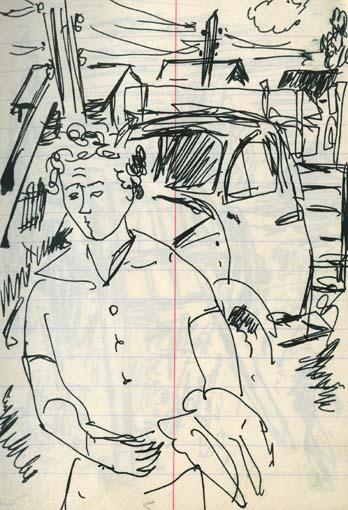
Untitled drawing by Joseph Brodsky / Image courtesy of the the National Library of Russia

Today in St. Petersburg, the National Library of Russia opened a new exhibit called "Hourglass: Drawings by Joseph Brodsky," featuring unpublished sketches by the Russian poet from a number of sources: the library's archives, the Anna Akhmatova Museum, and private collections. The exhibit also includes copies of drawings that Brodsky made during his years in the United States, as well as some of his photographs. According to the library's press release, "The drawings reflect yet another aspect of Joseph Brodsky's talent and are an important resource for the study of his life and work." Besides the images, the library has on display manuscripts of poems, excerpts from letters, and notebook entries.

As it so happens, the walls of my office at Saint Martin's University are adorned with printed copies of two drawings by Brodsky: a self-portrait and a sketch of Derek Walcott. Both come from Yale's Beinecke Library, whose website allows anyone to view a number of Brodsky's drawings and photographs from his manuscript collection. (Just search using the keyword "Brodsky.")

If any readers of this blog happen to be in St. Petersburg and find the time to drop by the exhibit at the National Library, I'd love to hear what you think! Unfortunately, the exhibit will be short-lived: it closes on December 31.

Printfriendly